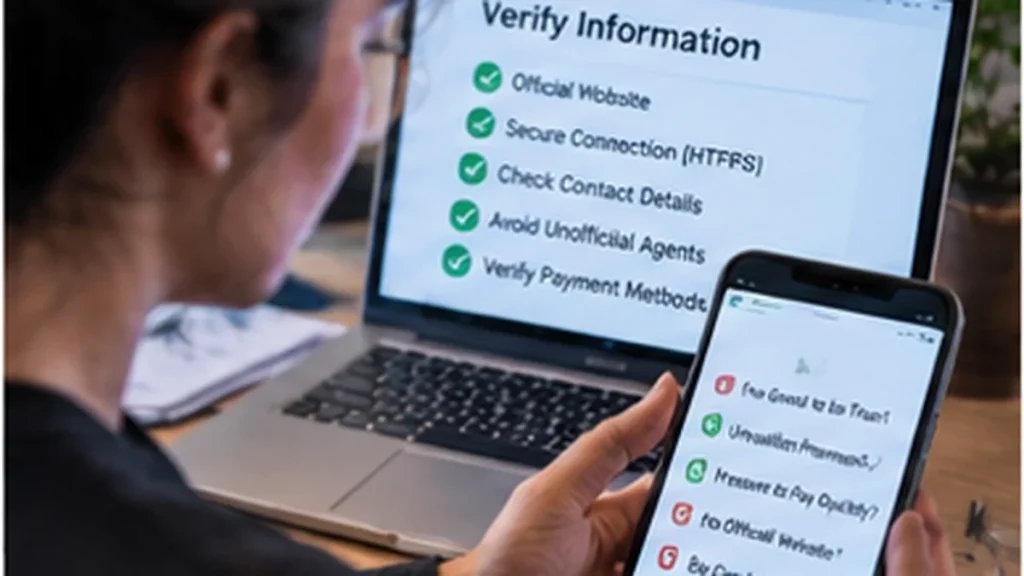
Visa scams visa scams often look professional because scammers copy government branding, use social media, claim access to officials, or promise faster approval. The safest habit is to verify information through the destination government’s official website before paying or sharing personal documents.
This article provides general informational guidance, not legal advice or a promise of visa approval. Immigration rules change, and the official authority for the destination country should always be the final source for current eligibility, fees, forms, processing steps, and legal requirements. For this visa scams topic, apply the principle only after checking the official route and country that apply to your own case.
Visa scams: verify the website address first
Start from the destination government’s main immigration or foreign-affairs website rather than clicking an advertisement or social-media link.
Look carefully at the domain. A professional design, official-looking seal, or paid search placement does not prove government affiliation.
For the section “Visa scams: verify the website address first,” note which point comes directly from an official source, which evidence supports it, and what still needs confirmation. In visa scams, this prevents a generic checklist from replacing the actual route rules.
Check whether a paid representative is authorized
Some countries regulate immigration representatives, consultants, lawyers, or advisers. Use the official regulator or government directory where one exists.
Do not rely on screenshots of certificates, social-media follower counts, or testimonials as proof of authorization.
After reviewing “Check whether a paid representative is authorized,” write one sentence explaining how it applies to your own case and one sentence identifying the official page you would use to verify it again before submission. This keeps visa scams tied to current evidence.
Question guaranteed approval or guaranteed speed
No private person can honestly guarantee that an immigration authority will approve an application.
Be cautious with claims of special connections, secret quotas, guaranteed visas, or paid access to faster decisions that do not appear on the official website.
Use “Question guaranteed approval or guaranteed speed” as a verification checkpoint: record the rule, the document or fact that answers it, and the date you last confirmed the requirement. That record is useful if visa scams preparation takes several weeks.
Verify fees and payment instructions
Check the official fee page and payment method. Government fees are usually paid through defined official channels, not to a personal bank account, gift card, cryptocurrency wallet, or private transfer.
If an agent charges a service fee, that is separate from the government’s decision and should be clearly explained.
Before moving past “Verify fees and payment instructions,” ask whether you know the answer from an official source or are only repeating advice from another applicant. For visa scams, unresolved assumptions should remain visible until they are verified.
Protect passport and financial information
Scammers may ask for passport copies, bank details, card numbers, passwords, or identity information before providing any verifiable service.
Share sensitive information only when you understand who is receiving it and why it is required.
For “Protect passport and financial information,” separate what is mandatory, what is optional, and what is merely helpful. This distinction makes visa scams preparation clearer and reduces unnecessary documents or payments.
Do not sign blank or false forms
You remain responsible for the information submitted in your name in many immigration systems, even when someone else prepares the application.
Review every answer and document before submission. Never agree to false employment, fake bank statements, altered certificates, or invented travel history.
Treat “Do not sign blank or false forms” as a consistency check. Compare the form, supporting evidence, and any sponsor or travel information, then resolve genuine differences through the proper official process before continuing with visa scams.
Be cautious with unexpected government messages
Threats of immediate arrest, deportation, account cancellation, or lost status unless you pay quickly are common scam patterns.
Use contact details from the official government website to verify any unexpected call, email, or message.
When you finish “Be cautious with unexpected government messages,” save the relevant government link and any confirmation number, receipt, or document connected to that step. Good record-keeping makes later visa scams questions easier to answer.
Save evidence and report suspected fraud
Keep screenshots, email addresses, payment instructions, website links, names, and messages if you suspect a scam.
Use the official reporting channel for the country involved and contact financial or law-enforcement authorities if money or identity information was stolen.
For “Save evidence and report suspected fraud,” identify the consequence of getting the point wrong. If the risk involves eligibility, money, privacy, or a legal deadline, verify it directly before relying on a third party during visa scams preparation.
Use a four-point verification test before paying anyone
Verify the website, the representative, the fee, and the payment destination separately. A real-looking website does not prove the representative is licensed; a licensed representative does not make a strange payment account legitimate. Treat each part as a separate check rather than allowing one convincing detail to validate the whole transaction.
Where a government provides an authorized-representative directory, search it yourself. Where official fees are published, compare the amount and payment method directly. Save screenshots or receipts only after you know you are using the genuine government or regulated-service channel.
Recognize pressure as a reason to slow down
Scammers often create urgency by claiming a quota will close, an officer is waiting, a visa is already approved, or your status will be cancelled unless you pay immediately. Genuine immigration processes can have deadlines, but those deadlines should be visible in official notices or rules—not only in a private message.
If you feel pressured, stop the transaction and verify using contact information found independently on the government website. Losing a few hours to verification is safer than losing money, identity documents, or control of an immigration account.
A realistic visa example
An applicant finds a website that looks official and promises guaranteed approval if a processing fee is paid by private transfer. They compare the domain with the real government site, discover that the fee and payment method do not match, and stop before sending passport and banking information.
The example does not guarantee the same outcome for another applicant. It shows how visa scams becomes safer when the applicant verifies the official rule, keeps evidence consistent, and avoids making irreversible decisions based on assumptions or sales pressure.
Connect this step to the rest of your visa preparation
Use use the official visa checker first when that becomes the next part of the application, and review check official processing times instead of paid promises when you need to verify or strengthen another part of the process.
Do not try to solve every visa question through one article. Each destination and visa route can have different definitions, evidence standards, deadlines, and legal consequences.
A seven-day preparation plan for visa scams
Day 1: identify the exact visa route and official authority. Day 2: read eligibility and document requirements. Day 3: collect only the evidence the route asks for. Day 4: verify fees, forms, and submission method. Day 5: check consistency and translations. Day 6: review privacy, fraud, and payment risks. Day 7: recheck the official page for changes before submitting or making a major payment. For this visa scams topic, apply the principle only after checking the official route and country that apply to your own case.
The schedule is only an organizational example. Some applications take far longer to prepare because documents, medicals, sponsorship, interviews, or translations may require additional time.
Practical checklist
- Official domain verified
- Representative authorization checked
- No guarantee accepted
- Fees checked on government site
- Payment method verified
- Sensitive data protected
- Forms reviewed before signing
- Suspicious activity documented
Use the checklist to organize visa scams, not to predict a decision. Immigration authorities make decisions under the law and rules that apply to the specific applicant and route.
Protect your immigration account as carefully as your passport
Use a unique password, multi-factor authentication when the official portal supports it, and an email account you control. Do not let an agent keep the only login or recovery access to an application submitted in your name. You should be able to review what is filed and receive official messages directly.
Be careful with screen-sharing, remote-access software, and requests for one-time security codes. A person who gains control of your immigration account may be able to change contact information, upload false documents, or intercept official notices.
If you stop using a representative, follow the immigration authority’s official procedure for updating or removing representation. Do not rely only on a private agreement with the agent when the government system still shows them as your contact.
Frequently Asked Questions
Can an agent guarantee visa scams will lead to approval?
No. A representative may help with preparation where legally allowed, but only the competent immigration authority can make the visa decision.
Should I rely on social media or forum advice?
Use personal experiences only as informal context. Verify every legal requirement, fee, form, document standard, and deadline on the destination government’s official website.
What if my situation is unusual?
Use the official contact channel or obtain advice from an authorized immigration professional or qualified lawyer for the jurisdiction involved.
Should I book non-refundable travel before approval?
Follow the visa authority’s instructions. Some authorities specifically advise applicants not to book travel until a decision is issued.
How do I know whether an immigration website is official?
Start from the country’s main government or foreign-affairs website, check the domain carefully, and use its own links to reach the visa service.
Official source to verify
For current official guidance related to this topic, review Immigration, Refugees and Citizenship Canada. If the page directs you to a local visa office, embassy, consulate, or separate immigration portal, follow that official route for your nationality and application location. For this visa scams topic, apply the principle only after checking the official route and country that apply to your own case.
Common warning signs that deserve extra verification
Be cautious when a representative refuses to provide a real business address, license or registration details where required, written service agreement, or receipt. Professional appearance on social media is not a substitute for verifiable authorization.
Another warning sign is a claim that the person can influence an officer, guarantee an appointment, create a visa without the normal application process, or obtain a government decision through a private contact. Verify every such claim through official channels.
Also be cautious when the payment account name does not match the business or government service you expect to pay. Stop and confirm before sending money.
Keep a private list of the official domains, application accounts, representative details, receipts, and payment channels you use. Scammers benefit when applicants cannot remember which website or contact handled which step. A clean record makes suspicious changes easier to notice—for example, a new email asking you to pay a different account or a message directing you away from the portal you used previously.
Final perspective
Visa scams is easier to manage when every important claim can be traced to an official rule or genuine document. Keep your information accurate, protect sensitive records, avoid guaranteed-result claims, and recheck official guidance whenever time passes between research and submission.