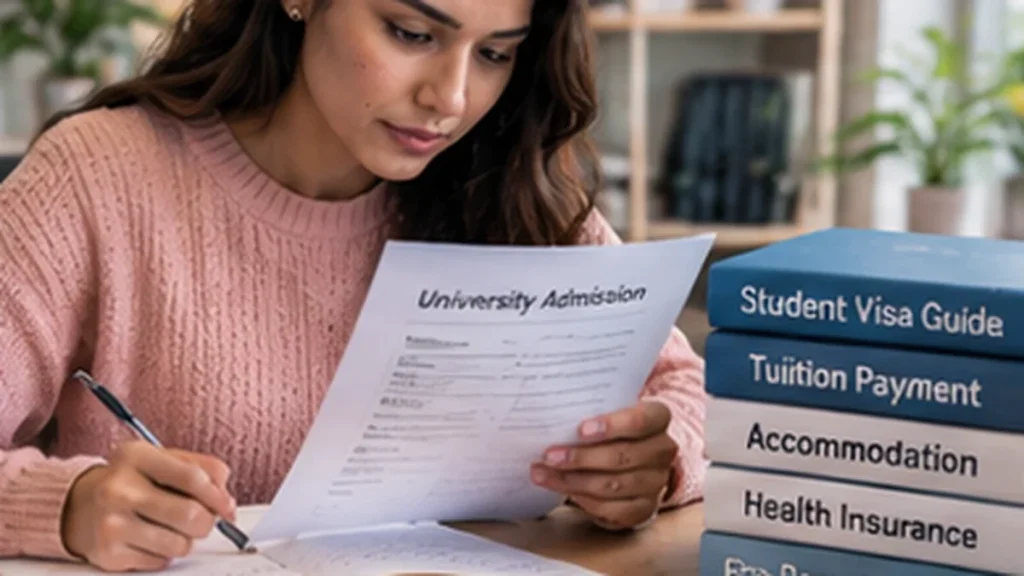
Student visa basics admission to a school and approval of a student visa are separate decisions. Before paying large tuition or accommodation deposits, confirm that the education provider and course fit the immigration rules, understand the refund policy, and check the current visa requirements on the destination government’s website.
This article provides general informational guidance, not legal advice or a promise of visa approval. Immigration rules change, and the official authority for the destination country should always be the final source for current eligibility, fees, forms, processing steps, and legal requirements. For this student visa basics topic, apply the principle only after checking the official route and country that apply to your own case.
Student visa basics: confirm the course and provider
Check whether the institution and course meet the immigration requirements for international students in the destination country.
Use the official education or immigration register when one exists rather than relying only on marketing materials from an agent.
For the section “Student visa basics: confirm the course and provider,” note which point comes directly from an official source, which evidence supports it, and what still needs confirmation. In student visa basics, this prevents a generic checklist from replacing the actual route rules.
Read the student visa route before paying large amounts
Understand the basic eligibility, enrollment evidence, financial requirements, health or insurance rules, age conditions, language evidence, and other route-specific requirements.
Do not assume admission automatically means you qualify for the visa.
After reviewing “Read the student visa route before paying large amounts,” write one sentence explaining how it applies to your own case and one sentence identifying the official page you would use to verify it again before submission. This keeps student visa basics tied to current evidence.
Review tuition and refund terms
Read what happens to tuition, deposits, accommodation payments, or other fees if the visa is refused or delayed.
Get the refund policy in writing and keep payment receipts.
Use “Review tuition and refund terms” as a verification checkpoint: record the rule, the document or fact that answers it, and the date you last confirmed the requirement. That record is useful if student visa basics preparation takes several weeks.
Prepare financial evidence from the official rule
Student routes may have specific requirements for tuition, living costs, sponsors, bank evidence, or how long funds must be held.
Use the current official figure and evidence standard immediately before you apply.
Before moving past “Prepare financial evidence from the official rule,” ask whether you know the answer from an official source or are only repeating advice from another applicant. For student visa basics, unresolved assumptions should remain visible until they are verified.
Check work conditions for students
Student work rights can include limits on hours, type of work, timing during study periods, or conditions for dependants.
Do not choose a study destination based on an assumption that part-time work will fully fund tuition or living costs.
For “Check work conditions for students,” separate what is mandatory, what is optional, and what is merely helpful. This distinction makes student visa basics preparation clearer and reduces unnecessary documents or payments.
Review health, insurance and medical requirements
Some student routes require health insurance, medical checks, or other health-related evidence.
Follow the official visa and education-provider instructions rather than purchasing a product simply because an agent recommends it.
Treat “Review health, insurance and medical requirements” as a consistency check. Compare the form, supporting evidence, and any sponsor or travel information, then resolve genuine differences through the proper official process before continuing with student visa basics.
Check visa timing before booking travel
Processing times can change and visa approval is not guaranteed. Avoid non-refundable travel when official guidance recommends waiting for a decision.
Coordinate course start dates, orientation, accommodation, and visa timing carefully.
When you finish “Check visa timing before booking travel,” save the relevant government link and any confirmation number, receipt, or document connected to that step. Good record-keeping makes later student visa basics questions easier to answer.
Protect yourself from education and visa scams
Verify agents, schools, payment accounts, and official documents before sending money or passport copies.
No agent can guarantee that an immigration authority will issue a student visa.
For “Protect yourself from education and visa scams,” identify the consequence of getting the point wrong. If the risk involves eligibility, money, privacy, or a legal deadline, verify it directly before relying on a third party during student visa basics preparation.
Build a study-and-visa timeline before paying large deposits
Map the admission deadline, tuition deposit, visa-application window, financial-evidence preparation, medical or biometrics steps if required, estimated processing time, accommodation payment, orientation, and course start date. The timeline shows where a delay could create financial risk and which payments are refundable.
Ask the education provider what happens if the visa decision is late or negative, and save the written refund policy. Do not rely only on an agent’s verbal promise about refunds or guaranteed visa approval.
Evaluate whether the study plan is financially sustainable
Combine tuition, visa fees, insurance, travel, accommodation, deposits, living costs, and emergency funds. Then compare that total with the funds you genuinely have access to. Part-time work rights, where permitted, should not be treated as a guaranteed way to finance the full plan.
If a sponsor is supporting the study, check both the visa evidence rules and the family’s real ability to maintain the plan over time. A student visa application is stronger when the academic plan and financial plan are both realistic.
A realistic visa example
A student receives an admission letter and is pressured to pay the full first year immediately through an unfamiliar agent. Before paying, they verify the institution, read the official student-visa route, confirm the school’s real payment account and refund policy, and compare the visa timing with the course start date.
The example does not guarantee the same outcome for another applicant. It shows how student visa basics becomes safer when the applicant verifies the official rule, keeps evidence consistent, and avoids making irreversible decisions based on assumptions or sales pressure.
Connect this step to the rest of your visa preparation
Use prepare financial evidence for study plans when that becomes the next part of the application, and review check official processing times before booking travel when you need to verify or strengthen another part of the process.
Do not try to solve every visa question through one article. Each destination and visa route can have different definitions, evidence standards, deadlines, and legal consequences.
A seven-day preparation plan for student visa basics
Day 1: identify the exact visa route and official authority. Day 2: read eligibility and document requirements. Day 3: collect only the evidence the route asks for. Day 4: verify fees, forms, and submission method. Day 5: check consistency and translations. Day 6: review privacy, fraud, and payment risks. Day 7: recheck the official page for changes before submitting or making a major payment. For this student visa basics topic, apply the principle only after checking the official route and country that apply to your own case.
The schedule is only an organizational example. Some applications take far longer to prepare because documents, medicals, sponsorship, interviews, or translations may require additional time.
Practical checklist
- Provider verified
- Course eligibility checked
- Visa route read
- Refund terms saved
- Financial rule checked
- Work conditions understood
- Health requirements reviewed
- Payment channel verified
Use the checklist to organize student visa basics, not to predict a decision. Immigration authorities make decisions under the law and rules that apply to the specific applicant and route.
Connect the visa plan to the real academic plan
Review the course duration, campus or delivery location, required attendance, start date, academic progression rules, and the amount already paid. The immigration application should reflect the study plan you genuinely intend to follow, not a generic explanation written by an agent.
Check whether a change of course, provider, study level, or enrollment status would affect the visa after arrival. Students often focus only on getting the first visa and overlook the conditions that continue during the period of study.
Keep education, visa, payment, insurance, accommodation, and sponsor records in one secure archive. If the provider changes a start date or issues a new enrollment document, check whether the immigration authority must also be informed.
Frequently Asked Questions
Can an agent guarantee student visa basics will lead to approval?
No. A representative may help with preparation where legally allowed, but only the competent immigration authority can make the visa decision.
Should I rely on social media or forum advice?
Use personal experiences only as informal context. Verify every legal requirement, fee, form, document standard, and deadline on the destination government’s official website.
What if my situation is unusual?
Use the official contact channel or obtain advice from an authorized immigration professional or qualified lawyer for the jurisdiction involved.
Should I book non-refundable travel before approval?
Follow the visa authority’s instructions. Some authorities specifically advise applicants not to book travel until a decision is issued.
How do I know whether an immigration website is official?
Start from the country’s main government or foreign-affairs website, check the domain carefully, and use its own links to reach the visa service.
Official source to verify
For current official guidance related to this topic, review Australian Department of Home Affairs. If the page directs you to a local visa office, embassy, consulate, or separate immigration portal, follow that official route for your nationality and application location.
Common mistakes in a student visa plan
Students sometimes choose a course mainly because an agent says it offers an easy visa or guaranteed work pathway. Immigration rules and post-study options can change, and the academic program should make sense even without a promised future immigration result.
Another mistake is paying large non-refundable amounts before reading both the school’s refund policy and the visa timing. Admission, visa approval, travel, accommodation, and enrollment are connected but separate decisions.
Do not rely on estimated part-time earnings to solve an unrealistic financial plan. Work rights may be limited, jobs are not guaranteed, and study obligations remain the main purpose of a student visa.
Students should also keep a backup academic plan for ordinary disruptions such as a delayed visa, deferred intake, provider change, or late arrival. Ask the school which options exist and whether any change affects enrollment documents or immigration requirements. Planning for disruption does not mean expecting refusal; it means protecting tuition, accommodation, and academic progress when an immigration timeline and an education calendar do not move at the same speed.
Final perspective
Student visa basics is easier to manage when every important claim can be traced to an official rule or genuine document. Keep your information accurate, protect sensitive records, avoid guaranteed-result claims, and recheck official guidance whenever time passes between research and submission.